If you run a fabrication shop that works with aluminum extrusions—say, for window frames, solar panel racks, or custom truck parts—you already know that getting the drilling speed right on your profile machine can make or not just cut quality, but also tool life, downtime, and per-part costs. As an aluminum profile drilling machine supplier, I’ve worked with dozens of fabricators over the last 12 years, and one question comes up more than any other: “How do I actually set the right speed when drilling aluminum without burning the material, snapping bits, or wasting half a shift troubleshooting?” It’s not a one-size-fits-all number, which is why so many shops either run too fast (ruining holes and bits) or too slow (dragging out production). Aluminum Profile Drilling Machine

Let’s start with the basics that most fabricators skip, because they’re focused on the machine’s controller dial instead of the material itself. Aluminum is soft, but not all aluminum is the same. 6061-T6, the go-to for structural parts, has a tensile strength of around 31,000 psi, while 6063-T5, used for non-structural trim, is closer to 21,000 psi. Even harder alloys like 7075-T6, often used for aerospace, can hit 83,000 psi. The hardness and alloy makeup directly dictate how fast you can spin the drill bit, and if you ignore that, you’re setting yourself up for problems.
Then there’s the profile’s wall thickness. A thin 1mm wall for a decorative trim piece will behave totally different from a 12mm thick extrusion for a structural beam. Thin walls can vibrate if you run too fast, leading to wobbly holes, while thick walls generate way more heat at the cutting edge, which is the #1 cause of dull bits in aluminum.
Now, the part everyone wants: the formula that actually works, not the random 1,000 RPM number someone told you years ago. Most drilling speed charts use surface feet per minute (SFM), which is the standard for metal cutting. For aluminum, general-purpose high-speed steel (HSS) drill bits (the most common for small shops) run between 200 and 500 SFM. Solid carbide bits, which are pricier but last 10x longer, can go up to 800 SFM. Here’s how to turn that into RPM for your drilling machine: RPM = (SFM × 3.82) ÷ drill diameter (in inches). Let’s test that with a common 1/4 inch HSS bit for 6061-T6, which we’ll set at 300 SFM. RPM = (300 × 3.82) ÷ 0.25 = 4,584 RPM. That’s a solid starting point. If you’re using the same bit on softer 6063-T5, bump that up to 400 SFM for 6,112 RPM, and on hard 7075-T6, drop to 250 SFM for 3,820 RPM.
But wait—there’s a catch here, because your profile drilling machine matters too. I’ve seen shops with old, worn machines with sloppy spindles run a 1/2 inch HSS bit at 3,000 RPM and snap it, while a newer, precision-balanced spindle on a machine we supply can run that same bit at 4,000 RPM without any issues. Why? Spindle runout: if your machine’s spindle has more than 0.001 inch of runout, the bit wobbles, which means the actual cutting speed isn’t what you calculated, and it creates extra friction and heat. That’s a big reason two shops with the same aluminum and drill bit can have totally different results.
Next up: feed rate, which is just as critical as speed, but almost never talked about in the same breath. Too many fabricators crank up speed and cut corners on feed, which is a recipe for disaster. For aluminum, feed rate is usually measured in thousandths of an inch per revolution (IPR). For HSS bits, that’s 0.001 to 0.003 IPR, and for carbide bits, it’s 0.002 to 0.005 IPR. Why the range? Smaller bits (under 1/4 inch) can’t handle as much feed because they’re more prone to snapping, while larger bits (over 1/2 inch) can take a heavier feed to remove material faster. Let’s go back to that 1/4 inch HSS bit at 4,584 RPM: a 0.002 IPR feed would be 9.16 inches per minute (IPM). That’s enough to cut through 6061-T6 cleanly without building up too much heat. If you run that feed at 0.0005 IPR, you’ll get a hole that’s too small, and the bit will rub instead of cut, dulling it in half the time. Run it at 0.004 IPR, and you’ll get a rough, oversize hole and a likely snapped bit.
Now, let’s talk about common mistakes I see every day, even from experienced fabricators. The first is ignoring coolant. Aluminum is prone to built-up edge (BUE), which is when tiny pieces of aluminum weld to the drill bit’s cutting edge, ruining hole finish and tool life. A flood coolant system for your profile drilling machine, or even a quality mist coolant, flushes that BUE away and keeps the bit cool. I’ve had a customer who was running 100 bits a month on 6061-T6 go to 12 bits a month just by adding a simple mist system to their machine—no other changes to speed or feed. It’s that impactful.
Another mistake is drilling too deep in one pass. If you’re drilling a 1 inch deep hole with a 2 inch long bit, you can’t just run straight through at your full speed. The bit will get packed with chips, generate too much heat, and snap. For holes deeper than 3x the drill diameter, you need to peck drill: pull the bit out of the hole every 1/2 inch to clear chips, then resume cutting. With a good profile drilling machine, this is a simple program setting, not something you have to do manually. One customer told me they used to break a bit every hour drilling 1.5 inch holes in 6061-T6, and after setting their machine to peck drill every 0.75 inches, they only break a bit once a week.
What about specialty cases? For example, if you’re drilling stacked aluminum profiles, or aluminum with a thin layer of plastic or steel on top, you can’t use the same speed as you would for solid aluminum. If you’re drilling through aluminum and then steel, drop your speed by 30% and run a light feed—steel will dull an aluminum drill bit fast, so you need to slow down to keep the edge sharp. If you’re drilling thin aluminum (under 3mm), run a slightly faster speed (50-100 SFM higher than your base for that alloy) and a lighter feed, so you don’t warp the profile. Warped parts mean you have to scrap them, which is way more expensive than a small adjustment to your speed settings.
I always tell fabricators that the best way to nail the right speed is to test it on a scrap piece of the same material, profile, and bit you’re going to use. Don’t just jump to production numbers. Cut a test hole, check the finish: it should be smooth, with no burr on the exit side. If there’s a burr or the hole is rough, slow down your speed by 10-15% or bump up your feed by 0.0005 IPR. If the bit is getting hot after a single hole, or if you hear a high-pitched squeal instead of a steady cutting sound, slow down too—heat is the enemy of aluminum drilling.
Now, let’s tie this back to using your profile drilling machine effectively. All the formulas I mentioned are useless if your machine can’t hold a consistent speed. That’s why when we design drilling machines for aluminum, we prioritize rigid spindles and variable speed drives that maintain RPM even when cutting through thick material. A lot of budget machines will drop speed when the bit hits hard aluminum, throwing all your calculations off. If your machine does that, you might need to adjust your initial speed by 10% to account for that speed drop, or invest in a machine with a more powerful spindle for consistent cutting.
Another tip: track your tool life. Keep a log of how many holes each drill bit makes at a certain speed and feed. After a few weeks, you’ll see a pattern: “At 4,500 RPM and 0.002 IPR, my HSS bits last 120 holes each.” If you lower the speed to 4,000 RPM, maybe they last 150 holes, and you only lose 10 minutes a day of production time. That trade-off is worth it if you’re spending $20 a bit for HSS—15% longer tool life means you buy fewer bits, which cuts costs way more than the small extra time per hole.
I’ve seen fabricators overcomplicate this for years, trying to find a magic number instead of working with the variables that actually matter. The right speed isn’t a random number off a chart—it’s a combination of your aluminum alloy, profile thickness, drill bit type, your machine’s capabilities, and even whether you’re using coolant. It takes 10 minutes of testing on scrap to get it right, and once you do, you’ll notice less downtime, fewer broken bits, and better quality parts that don’t require rework.
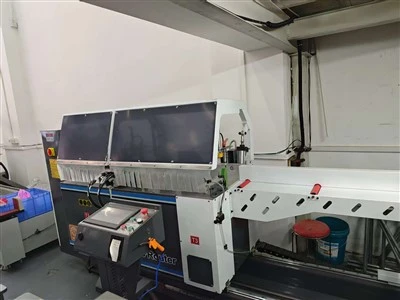
If you’re still struggling with setting speeds, or if you’re looking for a profile drilling machine that can handle all these adjustments consistently, feel free to reach out to our team to discuss your specific needs. We’ve worked with shops of all sizes—from small custom fabrication shops to large industrial operations—and we can help you dial in the exact settings for your material and production goals, no guesswork required.
Single Head Aluminium Cutter References
ASM International. (2008). Metal Cutting: Theory and Practice. ASM International.
Kakɩoɩannɩs, G., & Manolakos, D. (2011). Drilling of Aluminum Alloys: A Review of Process Parameters and Tool Performance. Journal of Manufacturing Processes.
Sandvik Coromant. (2022). Aluminum Drilling Guidelines. Sandvik Coromant Technical Guide.
Kanghong Building Materials Technology Sdn. Bhd.
As one of the most professional aluminum profile drilling machine manufacturers and suppliers in China, we have world-leading production equipment and strong manufacturing capabilities. Please feel free to wholesale advanced aluminum profile drilling machine for sale here from our factory. Customized orders are welcome.
Address: No.601, Block 2, Xinlianchang Industrial Park, No.2 Taixing Second Road, Taiping South Industrial Zone, Dali Town, Nanhai District, Foshan City
E-mail: 631871392@qq.com
WebSite: https://www.kanghong-building.com/
